Captains Compared: all 76 All Blacks Test captains, ranked fairly across 123 years
McCaw captained more Tests than the All Blacks played between 1903 and 1949. RUGBE rates every Test captain against what was expected of him, allowing for era, opponent, venue and the size of his sample, and scales each career to today's calendar. Andy Dalton, Richie McCaw, Buck Shelford and Brian Lochore lead the field.
Thursday, 5 November 2026
Richie McCaw captained the All Blacks in 110 Tests. Between 1903 and 1949 the All Blacks played 70 Tests in total. That one fact is why every ranking of All Blacks captains you have read is unfair to somebody.
Seventy-six men have captained New Zealand in a Test, from Jimmy Duncan in Sydney in 1903 to Codie Taylor in Sydney last month. They led in eras when the All Blacks played two Tests a year and eras when they played fourteen; in eras when a try was worth three points and eras when it is worth five; against Springbok sides that were the best in the world and Italian sides that were not. Two world wars took 13 years out of the calendar altogether. RUGBE has tried to put all 76 on the same scale.
Why the usual tables mislead
Most rankings use one number: the percentage of Tests won. It misleads in three ways.
Opportunity. A captain in the tour era could lead perhaps two Tests a year. Wilson Whineray captained 30 Tests between 1958 and 1965 and held the job for almost every Test New Zealand played in those eight years; in today's calendar that is roughly a hundred Tests. Counting raw Tests rewards modern captains for something they did not control.
Opposition. A win over the Springboks in Johannesburg is not the same as a win over Italy in Rome, and the All Blacks' fixture list has changed enormously. Raw win percentages reward captains who happened to play weaker teams, and teams at home.
Small samples. Thirty captains led New Zealand in three Tests or fewer. Several won every one. A perfect record over two Tests says almost nothing; an 89 percent record over 110 says a great deal.
How we measured it
Every Test was given an expected result: what the All Blacks would normally have been expected to achieve against that opponent, at that kind of venue (home, away or neutral), around that time. It is worked out from New Zealand's own record in that fixture within ten years either side of the Test (widened when there were too few games), with the captain's own Tests left out so nobody is measured against himself, and pulled towards New Zealand's overall record at that kind of venue so that a handful of matches cannot dominate. A Test against the 1949 Springboks in South Africa carried a low expectation; a Test against Italy at home carries a very high one.
From that come three measures:
- Wins above expected. Add up a captain's actual results (a draw counts as half a win) and subtract his expected results. A captain who won 15 Tests where 12 were expected is three wins above expected, whatever his era.
- The RUGBE rating. Wins above expected per 10 Tests, with a confidence adjustment: every captain starts as if he had already led ten Tests at exactly the expected level, so a short tenure cannot top the table on luck. A rating of +1.0 means about one extra win every ten Tests.
- Opportunity measures. The share of the job, the Tests he captained as a percentage of all Tests New Zealand played between his first and last, and a modern equivalent, his Tests scaled to today's calendar of about 13 Tests a year using the number of Tests New Zealand played each year of his tenure. War years, when no Tests were played, count against nobody.
Margins of victory need a fix too, because scoring changed: a try was worth three points until 1971, four until 1992 and five since, and the average Test now produces more than twice the points it did in the 1950s. Where we compare margins we express them as a share of the average total score of the decade.
The Test-by-Test record comes from New Zealand Rugby's official statistics, checked against Wikipedia's list of All Blacks Tests. Where a captain left the field, the man who led the team out is credited. Our counts may differ by one or two from figures you have seen elsewhere; the reasons are at the end.
The eras
| Era | Tests | Tests a year | All Blacks win rate | Average points per Test (both teams) | Captains |
|---|---|---|---|---|---|
| 1903-1914 | 24 | 2.0 | 83.3% | 22.6 | 9 |
| 1921-1938 | 36 | 2.0 | 61.1% | 22.9 | 14 |
| 1946-1969 | 82 | 3.42 | 76.8% | 20.7 | 15 |
| 1970-1986 | 83 | 4.88 | 68.1% | 28.3 | 12 |
| 1987-1995 | 70 | 7.78 | 80.0% | 46.8 | 5 |
| 1996-2011 | 189 | 11.81 | 82.0% | 53.0 | 13 |
| 2012-2026 | 189 | 12.6 | 81.5% | 53.7 | 12 |
The win rate counts a draw as half. No Tests were played from 1915 to 1920 or from 1939 to 1945, and those years are left out of the Tests-a-year figures.
The table shows why raw percentages mislead in both directions. The All Blacks won 83 percent of their Tests before the First World War, mostly against Australia and touring British sides, but only 61 percent between the wars, when the Springboks were their equal or better. A captain of the 1930s who won six of ten did as well, relative to his time, as a captain of the 2010s who won eight.
The established captains: 20 men who led ten Tests or more
| Rank | Captain | Years | Tests | W-L-D | Win % | Expected wins | Wins above expected | RUGBE rating | Share of the job | Modern equivalent |
|---|---|---|---|---|---|---|---|---|---|---|
| 1 | Andy Dalton | 1981-1985 | 17 | 15-2-0 | 88.2 | 11.8 | +3.2 | +1.19 | 70.8% | 39 |
| 2 | Richie McCaw | 2004-2015 | 110 | 97-11-2 | 89.1 | 84.4 | +13.6 | +1.13 | 74.3% | 108 |
| 3 | Buck Shelford | 1988-1990 | 14 | 13-0-1 | 96.4 | 10.8 | +2.7 | +1.11 | 100.0% | 28 |
| 4 | Brian Lochore | 1966-1970 | 18 | 15-3-0 | 83.3 | 12.2 | +2.8 | +0.99 | 90.0% | 58 |
| 5 | Reuben Thorne | 2002-2007 | 23 | 20-3-0 | 87.0 | 18.5 | +1.5 | +0.46 | 35.9% | 24 |
| 6 | Tana Umaga | 2004-2005 | 21 | 18-3-0 | 85.7 | 16.9 | +1.1 | +0.37 | 91.3% | 24 |
| 7 | Wilson Whineray | 1958-1965 | 30 | 22-5-3 | 78.3 | 22.1 | +1.4 | +0.34 | 90.9% | 94 |
| 8 | Gary Whetton | 1990-1991 | 15 | 12-3-0 | 80.0 | 11.2 | +0.8 | +0.34 | 100.0% | 23 |
| 9 | Graham Mourie | 1977-1982 | 19 | 15-4-0 | 78.9 | 14.2 | +0.8 | +0.27 | 65.5% | 45 |
| 10 | Kieran Read | 2012-2019 | 52 | 43-7-2 | 84.6 | 42.9 | +1.1 | +0.18 | 54.2% | 50 |
| 11 | Andy Leslie | 1974-1976 | 10 | 6-3-1 | 65.0 | 6.5 | +0.0 | +0.02 | 100.0% | 39 |
| 12 | Sean Fitzpatrick | 1992-1997 | 51 | 39-11-1 | 77.5 | 39.5 | +0.1 | +0.01 | 98.1% | 70 |
| 13 | Anton Oliver | 2001 | 10 | 8-2-0 | 80.0 | 8.0 | -0.0 | -0.01 | 100.0% | 13 |
| 14 | David Kirk | 1986-1987 | 11 | 9-2-0 | 81.8 | 9.0 | -0.0 | -0.01 | 84.6% | 22 |
| 15 | Sam Whitelock | 2017-2022 | 18 | 15-2-1 | 86.1 | 15.6 | -0.1 | -0.05 | 30.0% | 19 |
| 16 | Ardie Savea | 2021-2026 | 20 | 15-5-0 | 75.0 | 15.5 | -0.5 | -0.17 | 29.4% | 20 |
| 17 | Todd Blackadder | 2000 | 10 | 7-3-0 | 70.0 | 8.1 | -1.1 | -0.54 | 100.0% | 13 |
| 18 | Scott Barrett | 2024-2025 | 20 | 14-6-0 | 70.0 | 15.9 | -1.9 | -0.65 | 74.1% | 19 |
| 19 | Sam Cane | 2015-2023 | 27 | 18-8-1 | 68.5 | 22.7 | -4.2 | -1.14 | 25.7% | 28 |
| 20 | Taine Randell | 1998-2002 | 22 | 12-9-1 | 56.8 | 17.5 | -5.0 | -1.56 | 44.0% | 28 |
What the rankings say
Andy Dalton is first, and it is not a fluke. The Counties hooker captained 17 Tests between 1981 and 1985 and won 15, almost all of them against the hardest opposition there was: 14 wins from 16 Tests against South Africa, Australia, the British and Irish Lions, England and France. He took over when Graham Mourie made himself unavailable for the 1981 Springbok tour on grounds of conscience, won that series, and then beat the 1983 Lions in all four Tests. Expected to win about 12, he won 15. What the numbers cannot show is what he lost. He was captain-designate of the 1985 tour to South Africa that a court injunction stopped, captain of the rebel Cavaliers in 1986 until his jaw was broken in the second match, and named to lead the 1987 World Cup side until he was injured at training. David Kirk lifted the cup.
Richie McCaw is second, and on volume he has no rival. His rating per Test is a fraction below Dalton's, but he sustained it over 110 Tests, more than six times as long. He finished more than 13 wins above expected, the largest total by any captain by a distance; nobody else is above four. He won two World Cups, beat the big five nations in 59 of 72 Tests, and won 52 of his 64 Tests away from home or at neutral grounds. Expected to win about 84, he won 97, and drew two more. Even allowing for the strength of the teams he led, that is the most remarkable record in the table.
Buck Shelford is third, and still the only established captain who never lost. Thirteen wins and a draw from 14 Tests between 1988 and 1990, with winning margins, once the changes in scoring are allowed for, second only to David Kirk's among the established captains. He was dropped after the 1990 Scotland series; two months later, in the third Test after his omission, the side lost to Australia.
Brian Lochore is fourth. He took the job in the 1966 Lions series, which New Zealand won 4-0, led the side through most of a 17-Test winning run, and captained 90 percent of the Tests played in his time. His three defeats all came in the 1970 series in South Africa. Scaled to today's calendar, his 18 Tests are worth about 58.
Behind them is a clear gap. Reuben Thorne, Tana Umaga, Wilson Whineray and Gary Whetton all won a little more than their era and opponents would predict. Umaga's record looks better raw than adjusted because his 2005 Grand Slam and Lions whitewash came in a strong era; Whineray's looks better adjusted because he played 27 of his 30 Tests against the big five nations.
Sean Fitzpatrick sits almost exactly on the line, and that is the method working rather than failing. He won 39 of 51, a lower percentage than several men below him, but his side met Australia and South Africa every year in the new Tri-Nations, home and away, and he lost a World Cup final in extra time in Johannesburg. He also captained 98 percent of the Tests played in his six years, the firmest hold on the job of any modern captain, and his 51 Tests are worth about 70 in today's terms.
At the foot of the established list are Sam Cane and Taine Randell. Randell's tenure included five straight defeats in 1998 and the 1999 World Cup semi-final loss to France. Cane's included New Zealand's first defeat by Argentina, in Sydney in 2020, the first by Argentina in New Zealand, in 2022, and the first home series defeat by Ireland, all in an era in which the All Blacks were expected to win more than four Tests in five; he led them to the 2023 World Cup final, which they lost by a point after he was sent off. Scott Barrett (14 wins in 20, including a record 43-10 home defeat by South Africa and a first loss in Argentina) and Ardie Savea (15 in 20) are below the line too. Both captaincies are recent, and both were played in the toughest schedule New Zealand has had for decades.
Share of the job, and what a career is worth today
Some captains owned the role; others shared it. Shelford, Whetton, Leslie, Blackadder and Anton Oliver captained every Test New Zealand played while they were captain. Fitzpatrick (98 percent), Umaga (91), Whineray (91) and Lochore (90) were close. McCaw captained 74 percent of the Tests in his long span, because his tenure was interrupted by injury and rest, and Read 54 percent. Cane, captain of a side that was often led by others in his absence, led 26 percent.
Scaled to today's calendar of about 13 Tests a year, the most valuable captaincies are:
| Captain | Tests captained | Tests a year in his time | Modern equivalent |
|---|---|---|---|
| Richie McCaw | 110 | 13.1 | 109 |
| Wilson Whineray | 30 | 4.1 | 94 |
| Sean Fitzpatrick | 51 | 9.3 | 71 |
| Brian Lochore | 18 | 4.0 | 58 |
| Kieran Read | 52 | 13.4 | 50 |
| Graham Mourie | 19 | 5.5 | 45 |
| Cliff Porter | 7 | 2.2 | 42 |
| Andy Dalton | 17 | 5.6 | 39 |
| Andy Leslie | 10 | 3.3 | 39 |
Whineray, in other words, is the only captain whose tenure comes close to McCaw's once the calendar is accounted for.
The years nobody played
Wars cost no captain a Test in these tables, because no Tests were played: the gap after the 1914 tour of Australia lasted almost seven years, to the Springbok series of 1921, and the gap after the 1938 tour of Australia lasted eight, to Dunedin in September 1946, the longest in All Blacks history. But the wars cost men their careers.
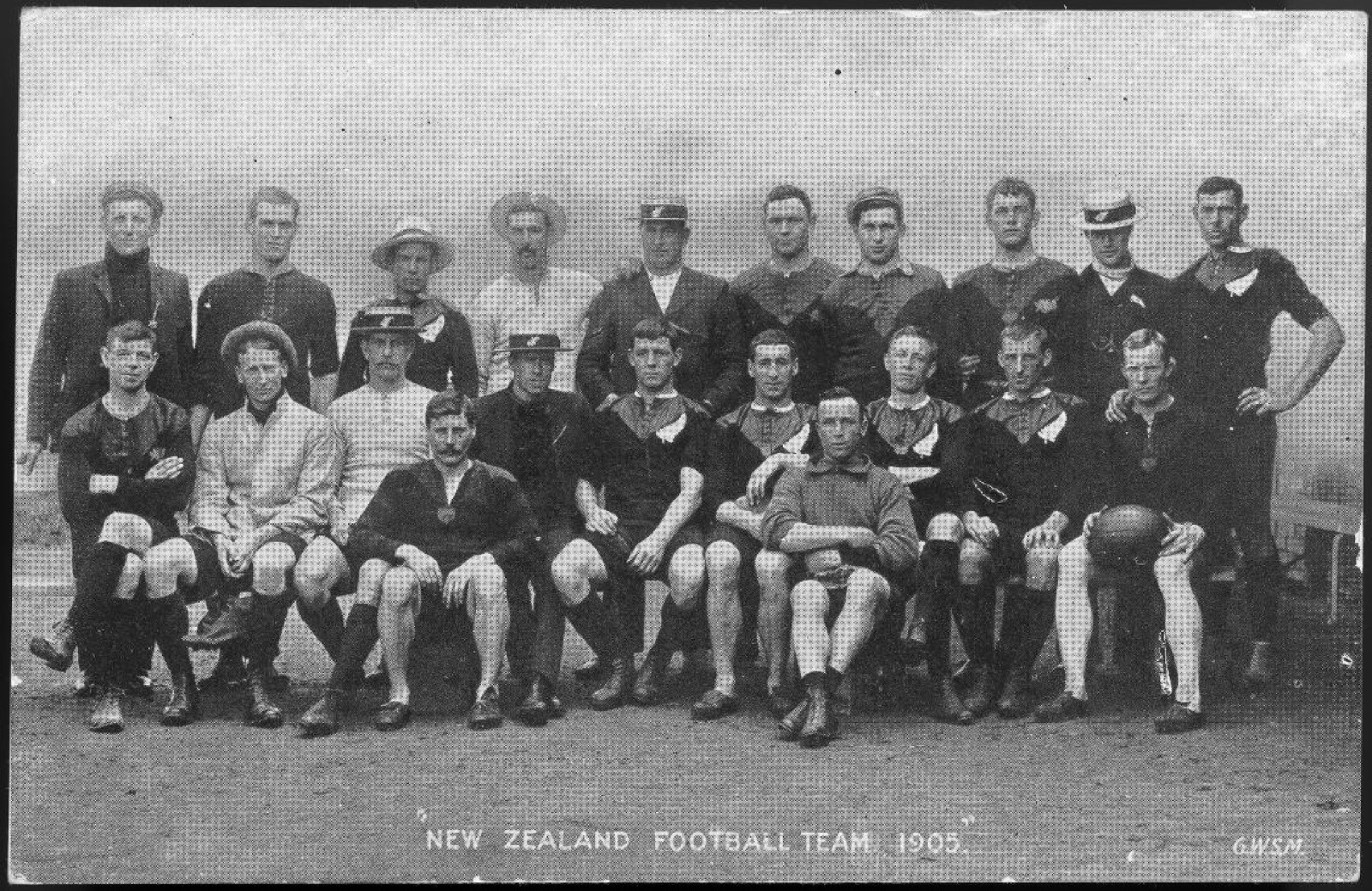
- Dave Gallaher, captain of the 1905 Originals, who won 34 of 35 matches on tour, had already retired when he enlisted in 1916, though exempt by age. He was fatally wounded at Broodseinde, part of the Passchendaele offensive, on 4 October 1917, one of 13 All Blacks killed in the First World War.
- Dick Roberts led the 1914 side in Australia to three Test wins from three, and never played another Test. He served with the New Zealand Rifle Brigade in 1918.
- Brushy Mitchell won both Tests he captained in Australia in 1938; there was no 1939.
- Fred Allen had captained Canterbury before he was called up in 1942 and was wounded twice, in the Solomon Islands and in Italy. His Test debut came in 1946, at 26, as captain. He later coached the All Blacks to 14 wins in 14 Tests.
- Jack Griffiths never played for the All Blacks again after 1938. He won the Military Cross in Italy.
Politics did the same in later decades. Māori players were excluded from the tours to South Africa in 1928, 1949 and 1960; in 1949 New Zealand played two Test series at once, in South Africa and at home against Australia, and lost all six Tests. The 1973 Springbok tour was cancelled by the government, the 1985 All Blacks tour was stopped in the High Court, and the 1986 rebel Cavaliers tour cost the players who went two Tests each. In 2020 Covid-19 cut the All Blacks to six Tests, Sam Cane's first year in charge.
The short tenures: 56 more captains
Most All Blacks captains led only a handful of Tests, as stand-ins for an injured captain or as tour captains in the years when there were only a few Tests to lead. The confidence adjustment keeps them from topping the table, but several did remarkable things.
- Jock Richardson led the 1924-25 Invincibles in their Tests against Ireland, Wales and England, because tour captain Cliff Porter was injured for much of the tour, and won all three. Porter himself captained the Test against France on that tour and the 1930 series against the Lions.
- Billy Stead captained four Tests and won all four, including New Zealand's first home Test, against Great Britain in Wellington in 1904.
- Peter Johnstone won all four Tests he captained in 1950 and 1951, including a 11-8 win over the 1950 Lions and a 3-0 series win in Australia.
- Bob Duff captained the last two Tests of the 1956 series against South Africa and won both, completing New Zealand's first series win over the Springboks.
- Colin Meads captained only one series, against the 1971 Lions, and it was the only series the Lions have won in New Zealand. It is the lowest rating in the whole table, which says more about the 1971 Lions than about Meads.
- Johnny Smith captained the two 1949 Tests against Australia and lost both, with a second-choice side, because the first-choice All Blacks were in South Africa.
- Ian Kirkpatrick led nine Tests in 1972 and 1973, including the 1972-73 tour of Britain, where a draw with Ireland cost a first Grand Slam.
Every captain is listed below in the order they first led the side, with the All Blacks' expected win rate in their time (the era baseline) alongside their own.
| Captain | Years | Tests | W-L-D | Win % | Era baseline % | Wins above expected | RUGBE rating |
|---|---|---|---|---|---|---|---|
| Jimmy Duncan | 1903 | 1 | 1-0-0 | 100.0 | 77.3 | +0.2 | +0.22 |
| Billy Stead | 1904-1908 | 4 | 4-0-0 | 100.0 | 73.0 | +1.0 | +0.73 |
| Jack Spencer | 1905 | 1 | 1-0-0 | 100.0 | 78.6 | +0.3 | +0.25 |
| Dave Gallaher | 1905-1906 | 4 | 3-1-0 | 75.0 | 86.4 | -0.3 | -0.19 |
| Jimmy Hunter | 1907-1908 | 4 | 2-0-2 | 75.0 | 83.9 | -0.5 | -0.33 |
| Fred Roberts | 1910 | 3 | 2-1-0 | 66.7 | 87.5 | -0.7 | -0.56 |
| Alex McDonald | 1913 | 2 | 2-0-0 | 100.0 | 74.0 | +0.5 | +0.44 |
| Joe O'Leary | 1913 | 2 | 1-1-0 | 50.0 | 77.8 | -0.8 | -0.62 |
| Dick Roberts | 1914 | 3 | 3-0-0 | 100.0 | 80.8 | +0.7 | +0.52 |
| George Aitken | 1921 | 2 | 1-1-0 | 50.0 | 72.2 | -0.1 | -0.08 |
| Ted Roberts | 1921 | 1 | 0-0-1 | 50.0 | 70.0 | -0.0 | -0.03 |
| Jock Richardson | 1924-1925 | 3 | 3-0-0 | 100.0 | 51.0 | +1.2 | +0.95 |
| Cliff Porter | 1925-1930 | 7 | 4-3-0 | 57.1 | 61.3 | -0.8 | -0.49 |
| Maurice Brownlie | 1928 | 4 | 2-2-0 | 50.0 | 60.5 | +0.7 | +0.49 |
| Herbie Lilburne | 1929 | 1 | 0-1-0 | 0.0 | 61.4 | -0.6 | -0.52 |
| Archie Strang | 1931 | 1 | 1-0-0 | 100.0 | 62.5 | +0.3 | +0.32 |
| Frank Kilby | 1932-1934 | 4 | 2-1-1 | 62.5 | 57.9 | +0.6 | +0.41 |
| Rusty Page | 1934 | 1 | 0-1-0 | 0.0 | 61.4 | -0.6 | -0.52 |
| Jack Manchester | 1935-1936 | 4 | 2-2-0 | 50.0 | 54.4 | -0.9 | -0.68 |
| Jack Griffiths | 1936 | 2 | 2-0-0 | 100.0 | 70.0 | +0.3 | +0.28 |
| Ron King | 1937 | 3 | 1-2-0 | 33.3 | 88.9 | -1.2 | -0.92 |
| Brushy Mitchell | 1938 | 2 | 2-0-0 | 100.0 | 50.0 | +1.0 | +0.83 |
| Rod MacKenzie | 1938 | 1 | 1-0-0 | 100.0 | 52.5 | +0.5 | +0.42 |
| Fred Allen | 1946-1949 | 6 | 4-2-0 | 66.7 | 67.5 | +0.2 | +0.12 |
| Johnny Smith | 1949 | 2 | 0-2-0 | 0.0 | 75.0 | -1.4 | -1.19 |
| Ron Elvidge | 1949-1950 | 5 | 2-2-1 | 50.0 | 68.6 | -0.6 | -0.39 |
| Peter Johnstone | 1950-1951 | 4 | 4-0-0 | 100.0 | 54.3 | +1.0 | +0.71 |
| Kevin Skinner | 1952 | 2 | 1-1-0 | 50.0 | 75.0 | -0.3 | -0.29 |
| Bob Stuart | 1953-1954 | 5 | 3-2-0 | 60.0 | 67.7 | -0.7 | -0.43 |
| Ian Clarke | 1955 | 3 | 2-1-0 | 66.7 | 75.0 | +0.0 | +0.02 |
| Pat Vincent | 1956 | 2 | 1-1-0 | 50.0 | 78.0 | -0.6 | -0.52 |
| Bob Duff | 1956 | 2 | 2-0-0 | 100.0 | 75.6 | +0.6 | +0.50 |
| Ponty Reid | 1957 | 2 | 2-0-0 | 100.0 | 69.0 | +0.2 | +0.19 |
| Wilson Whineray | 1958-1965 | 30 | 22-5-3 | 78.3 | 75.7 | +1.4 | +0.34 |
| John Graham | 1964 | 3 | 2-1-0 | 66.7 | 79.5 | -0.4 | -0.32 |
| Brian Lochore | 1966-1970 | 18 | 15-3-0 | 83.3 | 72.1 | +2.8 | +0.99 |
| Chris Laidlaw | 1968 | 1 | 1-0-0 | 100.0 | 69.2 | +0.2 | +0.15 |
| Kelvin Tremain | 1968 | 1 | 1-0-0 | 100.0 | 79.2 | +0.1 | +0.08 |
| Colin Meads | 1971 | 4 | 1-2-1 | 37.5 | 83.3 | -1.9 | -1.39 |
| Ian Kirkpatrick | 1972-1973 | 9 | 6-2-1 | 72.2 | 74.4 | -0.7 | -0.35 |
| Andy Leslie | 1974-1976 | 10 | 6-3-1 | 65.0 | 72.1 | +0.0 | +0.02 |
| Tane Norton | 1977 | 4 | 3-1-0 | 75.0 | 79.8 | +0.1 | +0.07 |
| Graham Mourie | 1977-1982 | 19 | 15-4-0 | 78.9 | 70.1 | +0.8 | +0.27 |
| Frank Oliver | 1978 | 3 | 2-1-0 | 66.7 | 80.6 | -0.2 | -0.15 |
| Dave Loveridge | 1980 | 3 | 1-2-0 | 33.3 | 69.8 | -1.2 | -0.93 |
| Andy Dalton | 1981-1985 | 17 | 15-2-0 | 88.2 | 75.4 | +3.2 | +1.19 |
| Stu Wilson | 1983 | 2 | 0-1-1 | 25.0 | 69.8 | -1.1 | -0.90 |
| Jock Hobbs | 1985-1986 | 4 | 2-1-1 | 62.5 | 66.6 | -0.6 | -0.40 |
| David Kirk | 1986-1987 | 11 | 9-2-0 | 81.8 | 83.3 | -0.0 | -0.01 |
| Buck Shelford | 1988-1990 | 14 | 13-0-1 | 96.4 | 76.0 | +2.7 | +1.11 |
| Gary Whetton | 1990-1991 | 15 | 12-3-0 | 80.0 | 76.5 | +0.8 | +0.34 |
| Sean Fitzpatrick | 1992-1997 | 51 | 39-11-1 | 77.5 | 80.6 | +0.1 | +0.01 |
| Paul Henderson | 1995 | 1 | 1-0-0 | 100.0 | 85.7 | +0.1 | +0.05 |
| Justin Marshall | 1997 | 4 | 3-0-1 | 87.5 | 72.9 | +0.4 | +0.29 |
| Taine Randell | 1998-2002 | 22 | 12-9-1 | 56.8 | 82.3 | -5.0 | -1.56 |
| Todd Blackadder | 2000 | 10 | 7-3-0 | 70.0 | 80.0 | -1.1 | -0.54 |
| Anton Oliver | 2001 | 10 | 8-2-0 | 80.0 | 79.1 | -0.0 | -0.01 |
| Reuben Thorne | 2002-2007 | 23 | 20-3-0 | 87.0 | 82.5 | +1.5 | +0.46 |
| Tana Umaga | 2004-2005 | 21 | 18-3-0 | 85.7 | 84.3 | +1.1 | +0.37 |
| Richie McCaw | 2004-2015 | 110 | 97-11-2 | 89.1 | 80.1 | +13.6 | +1.13 |
| Jerry Collins | 2006-2007 | 3 | 3-0-0 | 100.0 | 78.3 | +0.5 | +0.37 |
| Rodney So'oialo | 2008-2009 | 5 | 3-2-0 | 60.0 | 86.5 | -1.2 | -0.78 |
| Keven Mealamu | 2008-2011 | 3 | 2-1-0 | 66.7 | 83.1 | -0.6 | -0.46 |
| Mils Muliaina | 2009 | 3 | 2-1-0 | 66.7 | 93.2 | -0.9 | -0.72 |
| Andrew Hore | 2011 | 1 | 1-0-0 | 100.0 | 92.7 | +0.0 | +0.03 |
| Kieran Read | 2012-2019 | 52 | 43-7-2 | 84.6 | 82.6 | +1.1 | +0.18 |
| Sam Cane | 2015-2023 | 27 | 18-8-1 | 68.5 | 83.4 | -4.2 | -1.14 |
| Ben Smith | 2017 | 1 | 1-0-0 | 100.0 | 89.3 | +0.1 | +0.05 |
| Sam Whitelock | 2017-2022 | 18 | 15-2-1 | 86.1 | 81.7 | -0.1 | -0.05 |
| Luke Whitelock | 2018 | 1 | 1-0-0 | 100.0 | 76.7 | +0.1 | +0.12 |
| Aaron Smith | 2021 | 1 | 1-0-0 | 100.0 | 89.8 | +0.1 | +0.05 |
| Ardie Savea | 2021-2026 | 20 | 15-5-0 | 75.0 | 79.7 | -0.5 | -0.17 |
| Brodie Retallick | 2021 | 1 | 1-0-0 | 100.0 | 77.4 | +0.2 | +0.19 |
| Scott Barrett | 2024-2025 | 20 | 14-6-0 | 70.0 | 79.2 | -1.9 | -0.65 |
| Patrick Tuipulotu | 2024 | 1 | 1-0-0 | 100.0 | 73.1 | +0.1 | +0.14 |
| Codie Taylor | 2026 | 3 | 2-1-0 | 66.7 | 77.0 | -0.2 | -0.18 |
Before the first Test
New Zealand teams had captains long before the first Test in Sydney in 1903. William Millton led the first New Zealand side to travel overseas, to New South Wales in 1884, and won all eight matches. Joe Warbrick captained the 1888-89 New Zealand Native team, the first New Zealand side to perform a haka and to wear black, which played 107 matches in New Zealand, Australia and Britain; injury restricted him to 21 of them. Thomas Ellison led the first side sanctioned by the New Zealand Rugby Football Union, to Australia in 1893, and won nine of ten, and Alf Bayly did the same in 1897. Jimmy Duncan led New Zealand in 1901 and in that first Test.
In the tour era many of the matches that defined a captain were not Tests. Gallaher's Originals played 35 matches and five Tests; Mourie captained 57 matches but only 19 Tests; Fred Allen captained all 21 of his All Blacks matches, six of them Tests. These tables measure Tests only, because Tests are the only matches that can be compared across all 123 years.
The fine print
- Counts. The record is New Zealand Rugby's official one, checked Test by Test against Wikipedia. Published figures for some captains differ because of how stand-in captaincies are counted: you will see McCaw credited with 110, 111 or 113 Tests, and Shelford, Dalton and Lochore each one either side of our figures. In Chicago in November 2025 Scott Barrett led the side out and went off injured after three minutes; we credit Barrett, who started as captain, so he and Savea have 20 each.
- What the rating does not measure. A captain does not pick the team, and the expected result is built from the All Blacks' own record, so it measures performance against the standard of the time, not against some absolute scale. Leadership, the men a captain brought through and the respect he held are not in any table, and should not be.
- Recent captains have the least settled ratings, because the method compares them with only half a window of Tests after their time. Expect Savea's, Barrett's and Codie Taylor's numbers to move.
Codie Taylor, the 76th, leads the All Blacks against Scotland at Murrayfield on Sunday morning. On this method the expectation at Murrayfield is high, about 0.84 of a win, because New Zealand have never lost to Scotland: a win adds only about a sixth of a win to his rating, and a first defeat would cost him more than four-fifths of one.
Sources: New Zealand Rugby, All Blacks statistics (stats.allblacks.com), every Test 1903-2026; Wikipedia, List of New Zealand rugby union Test matches and individual captains' pages; NZ Herald (Phil Gifford, 2020); RUGBE analysis.
🗳️ Who is the greatest All Blacks captain?
Everyone can vote, no sign-in needed.
🗳️ Is it fair to judge a captain on results at all?
Everyone can vote, no sign-in needed.
Sources & further reading
This story draws on the reporting below. The original journalism deserves your click.
- All Blacks statistics: match records 1903-2026 , New Zealand Rugby
- List of New Zealand rugby union Test matches , Wikipedia
- New Zealand national rugby union team , Wikipedia
- Dave Gallaher , Wikipedia
- Fred Allen (rugby union) , Wikipedia
- New Zealand Cavaliers , Wikipedia
- 1924-25 New Zealand tour of Britain, Ireland and France , Wikipedia
- 1888-89 New Zealand Native football team , Wikipedia
- List of international rugby union players killed in World War I , Wikipedia
- Phil Gifford: rating the best All Blacks captains (2020) , NZ Herald
Comments (0)
Sign in to join the conversation.