The Lost Caps: the All Blacks careers taken by two world wars, apartheid, a rebel tour and a pandemic
Not one of the 19 men who played a Test in 1938 played another; every All Black in the first Test after the war was a debutant. Twenty All Blacks died in the two wars, Māori players were barred from three tours of South Africa, and a two-Test ban in 1986 ended careers and started Sean Fitzpatrick's. Who lost what, with RUGBE's estimates.
Thursday, 5 November 2026
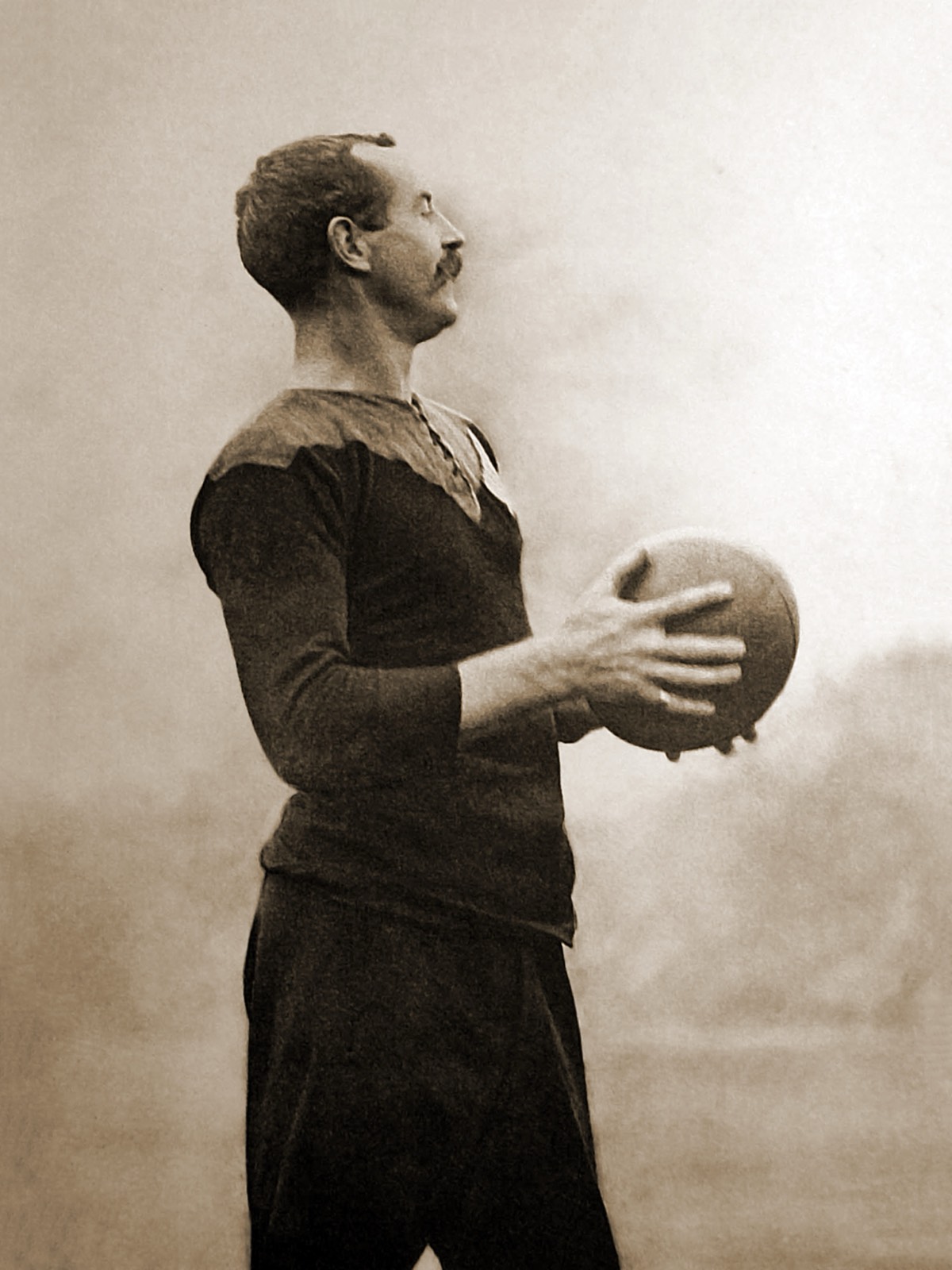
On 14 September 1946 the All Blacks ran out at Carisbrook for their first Test in eight years, and beat Australia 31-8. Every one of the fifteen men in black was making his Test debut. Not one of the 19 men who had played a Test in 1938 ever played another. The captain, Fred Allen, was 26 and had been wounded twice, in the Solomon Islands and in Italy. A generation of All Blacks had simply vanished.
This is the story of the caps that were never won: the players whose Test careers were ended, delayed or never started because of two world wars, the exclusion of Māori players from tours of South Africa, a rebel tour, and a pandemic. Where we can, we estimate what each of them lost. The estimates are ours, the arithmetic is shown, and they should be read as illustrations rather than facts.
How we estimate a lost career
An All Black's lost Tests depend on two things: how many Tests New Zealand would have played in the missing years, and how often he was picked when he was available. So our estimate is the Tests that would have been played in the gap, at the rate of the time, multiplied by the share of available Tests the player won while he was an All Black, and stopped when he would have been about 32 or 33.
The rate matters enormously. Before the Second World War the All Blacks played about two Tests a year, mostly on tours a few years apart. In the 1930s it was nearer three. Today it is about 13. A four-year gap cost a pre-war All Black perhaps eight Tests; the same gap now would cost fifty.
The First World War: 13 dead, seven of them in their prime
No Tests were played between the third Test in Sydney on 15 August 1914, played after Britain and New Zealand were already at war, and the first Test against the Springboks in Dunedin on 13 August 1921. At two a year, that is about 12 Tests the All Blacks never played.
Thirteen All Blacks were killed. Six had finished their careers by 1910, among them Dave Gallaher, the captain of the 1905 Originals, who enlisted in 1916 although he was exempt by age and was killed at Broodseinde, part of the Passchendaele offensive, on 4 October 1917. Seven were current All Blacks, aged between 20 and 30 when Tests stopped:
| Player | Position, province | Tests | Age in August 1914 | Died | RUGBE estimate of Tests lost |
|---|---|---|---|---|---|
| Doolan Downing | Lock, Auckland | 5 | 28 | 8 August 1915, Chunuk Bair, Gallipoli | about 6 |
| Henry "Norkey" Dewar | Loose forward, Taranaki | 2 | 30 | 9 August 1915, Gallipoli | about 2 |
| Bobby Black | First five-eighth, Otago | 1 | 20 | 21 September 1916, the Somme | a whole career |
| George Sellars | Hooker, Auckland | 2 | 28 | 7 June 1917, Messines | about 3 |
| Jim Baird | Centre, Otago | 1 | 20 | 7 June 1917, of wounds, Messines | a whole career |
| Reg Taylor | Wing forward, Taranaki | 2 | 25 | 20 June 1917, Messines | about 3 |
| Jim McNeece | Forward, Southland | 5 | 28 | 21 June 1917, of wounds from Messines | about 6 |
Downing was the first All Black killed in the war, the day before his team-mate Dewar. Jim Baird is the cruellest case. He was called into the Test against Australia at Carisbrook in 1913 only because he was the nearest player available when Eric Cockroft withdrew; New Zealand won 25-13; he was picked again but withdrew injured, missed 1914 through illness, and was dead at 23. Bobby Black played his only Test in Sydney in July 1914 and was killed on the Somme, also at 23.
The survivors lost almost as much. Only one man played Tests on both sides of the war: halfback Teddy Roberts, who played in 1914 and captained the third Test against South Africa in 1921. Others came home and were never picked for a Test again.
- Dick Roberts captained the unbeaten 1914 tour of Australia, served with the New Zealand Rifle Brigade and starred for the New Zealand Army side in 1919, but never played for the All Blacks again. Estimate: about eight Tests lost.
- Ranji Wilson was, in the words of the New Zealand Rugby Museum, acknowledged as the best loose forward in New Zealand before the war. He served as a sergeant, was a star of the Army team that won the King's Cup in 1919, and was barred from the Army's tour of South Africa that year because he was classed as "coloured". He played on for Wellington into his mid-thirties, never for the All Blacks, and later helped pick the 1924-25 Invincibles. Estimate: about six Tests lost.
- The 1919 Army side's South African manager, Percy Day, judged its best fifteen superior to the best the 1928 All Blacks could field. Several of its stars, including Jimmy Ryan, its captain, Jack Stohr and Alex Bruce, never played another All Blacks match.
The Second World War: the 1940 tour that never sailed
The gap was longer this time: from Sydney on 13 August 1938 to Dunedin on 14 September 1946, eight years and a month, the longest in All Blacks history. At the 1930s rate of nearly three a year, about 20 Tests were never played. Four of them would probably have come on a tour of South Africa scheduled for 1940; trials were held in 1939 to pick it.
Seven All Blacks died in or because of the war.
- Donald Cobden played one Test, against South Africa in Wellington in 1937, and lasted 25 minutes before injury forced him off. He joined the RAF, flew Spitfires with No. 74 Squadron and was shot down over the Channel in the Battle of Britain on 11 August 1940, his 26th birthday.
- Art Wesney, a captain in the 26th Battalion, was killed leading a charge at Sidi Rezegh in Libya in November 1941, aged 26. He had been in the 1939 trials for the 1940 tour.
- Jim Wynyard toured Britain in 1935 at 20, starred in the final 1939 trial, and was killed at El Alamein in November 1942, aged 28.
- Cyril Pepper won the Military Cross in North Africa, was invalided home after losing an eye, and died in Wellington in 1943, aged 31.
- Jack Harris, who lost the 1924-25 Invincibles fullback spot to a teenage George Nepia, served in his forties and died of wounds in Italy in May 1944.
- George Hart, an 11-Test wing and New Zealand's 100 yards champion in 1931, was a captain in the 20th Armoured Regiment when he was killed by a shell during the advance on Rome in June 1944.
- Bill Carson, also a New Zealand cricketer who scored 290 in his second first-class innings, won the Military Cross and died on a hospital ship in October 1944, aged 28.
Many more lost their careers. The New Zealand Rugby Museum's profiles say the war ended the Test careers of lock Ron King, after 13 consecutive Tests, of Charlie Saxton, the incumbent Test halfback and "strongest of candidates" for 1940, and of Trevor Berghan, Tom Morrison and Les George, all regarded as near-certain tourists. Saxton went on to captain the 2NZEF "Kiwis" army side that toured Britain and Europe in 1945-46, more than half of whom became All Blacks, and later managed the All Blacks. Our estimate for Saxton is 15 to 20 Tests.
Others started late. Nine of the debutants of 1946 were 25 or older; hooker Has Catley was 30, prop Pat Rhind 31 and forward Jack McRae 32. Bob Stuart, who would captain the All Blacks in Britain in 1953-54, did not make his Test debut until 1949, at 28, after serving with the Fleet Air Arm.
South Africa: the caps denied by race
For half a century New Zealand sent teams to South Africa without the players South Africa would not accept.
- 1928. Fullback George Nepia, who had played every match of the Invincibles tour as a teenager, and halfback Jimmy Mill were declared ineligible because they were Māori. Nepia played nine of the 11 All Blacks Tests between 1924 and 1930 outside that tour; he would very probably have played all four in South Africa, for 13 of 15.
- 1949. The rule cost New Zealand its best halfback. Vince Bevan, the Museum says, should have been the number one halfback in South Africa, but a reference to a trace of Māori ancestry made him ineligible; the All Blacks lost the series 4-0, and halfback proved one of their critical weaknesses. Centre Johnny Smith, whom Bob Scott called the best three-quarter he saw "bar none", wing Ben Couch and Peter Smith were also ruled out, along with Kiwi Blake, who was excluded although his ancestry was African rather than Māori. New Zealand played two Tests against Australia at home the same season with a second team captained by Johnny Smith, one of them on the same day as a Test in South Africa, and lost both. Johnny Smith was never an All Black again.
- 1960. Māori were excluded again, after a "No Maoris, No Tour" campaign and a petition of 150,000 signatures. No source we found names the players who would have gone.
- 1967 was cancelled by the government and replaced by a tour of Europe; 1970 went ahead with Māori and Pacific players admitted as "honorary whites"; the 1973 Springbok tour of New Zealand was cancelled by Prime Minister Norman Kirk, leaving a single home Test that year; and the 1985 All Blacks tour was stopped in the High Court and replaced by two Tests in Argentina.
1981: two who said no
Captain Graham Mourie made himself unavailable for the 1981 Springbok series on grounds of conscience and came back to lead the side again later. Centre Bruce Robertson, embittered by what he had seen on the 1976 tour, stood down on principle as well. His last match was the Scotland Test at Eden Park that June, in which he scored a try. He never played for the All Blacks again, after 34 Tests, at 29.
1986: the Cavaliers and the Baby Blacks
When 28 of the 30 players chosen for the stopped 1985 tour went to South Africa anyway in 1986 as the unofficial Cavaliers, New Zealand Rugby banned them all from the next two All Blacks Tests: France in Christchurch on 28 June, won 18-9, and Australia in Wellington on 9 August, lost 13-12. Only David Kirk and John Kirwan had stayed home; Kirk captained the replacements, the "Baby Blacks".
The ban ended careers and started them. Victor Simpson, a centre with two Tests, served his ban to find that Joe Stanley, given his chance in the Baby Blacks, had become the preferred centre; he was never in the running again. Eight Cavaliers who had played a Test in 1985 never played another, among them Andy Dalton, Andy Haden, Murray Mexted and Dave Loveridge. Thirteen Baby Blacks made their debuts in the two banned Tests. One of them was a hooker called Sean Fitzpatrick, who went on to play 92 Tests and captain New Zealand. Four of them, Brett Harvey, Gordon Macpherson, Brent Anderson and Michael Speight, never played another: their only Test cap is a ban Test.
2020: the pandemic
Covid-19 cost the All Blacks at least five Tests in 2020: two against Wales and one against Scotland in July, and two against South Africa when the Springboks withdrew from the Rugby Championship. New Zealand played six instead of a normal 12 or more. No All Black's career was clearly ended by it; the season's veterans, from Kieran Read to Ben Smith, had played their last Test at the 2019 World Cup. But every regular of 2020, starting with new captain Sam Cane, carries about five fewer caps than he would have had.
The money and the league
War and politics were not the only thieves. Eight All Blacks, among them 1905 Originals George Smith and Duncan McGregor, joined the professional "All Golds" tour of 1907-08 and were banned from rugby union for life; Edgar Wrigley had played one Test at 19. George Nepia, after hardship in the Depression, went to rugby league in Britain. Later converts included 1938 Test player Harold Milliken, whose league tour of Britain was abandoned when the Second World War began, and Baby Black Frano Botica in 1990.
What it adds up to
On our arithmetic the two wars alone took about 32 Tests from New Zealand's calendar, about one in seven of all the Tests the All Blacks played before 1987. They took twenty All Blacks' lives. And they broke the continuity of the team twice: one player crossed the first gap, none crossed the second.
The lost caps can never be awarded. But they are why a list of the most-capped All Blacks will always be a list of modern players, and why the record books need reading with the calendar beside them.
Sources: New Zealand Rugby Museum player profiles on stats.allblacks.com (mostly by Lindsay Knight); allblacks.com, "Anzac Day and the All Blacks" (2012, archived); Wikipedia, List of international rugby union players killed in World War I, New Zealand Army rugby team of 1919, 1945-46 Victory Internationals, New Zealand Cavaliers, 1960 tour and individual players; 1News (May 2020); RUGBE Test-by-Test data and estimates.
🗳️ Whose lost career is the hardest to read about?
Everyone can vote, no sign-in needed.
🗳️ Should New Zealand award retrospective caps, as Wales did for its 1945-46 Victory Internationals?
Everyone can vote, no sign-in needed.
Sources & further reading
This story draws on the reporting below. The original journalism deserves your click.
- All Blacks player profiles , New Zealand Rugby Museum / stats.allblacks.com
- Anzac Day and the All Blacks (2012) , allblacks.com (archived)
- List of international rugby union players killed in World War I , Wikipedia
- New Zealand Army rugby team of 1919 , Wikipedia
- 1945-46 Victory Internationals , Wikipedia
- 1960 New Zealand rugby union tour of Australia and South Africa , Wikipedia
- New Zealand Cavaliers , Wikipedia
- Donald Cobden , Wikipedia
- July Tests for All Blacks, Black Ferns indefinitely postponed due to Covid-19 , 1News
Comments (0)
Sign in to join the conversation.